
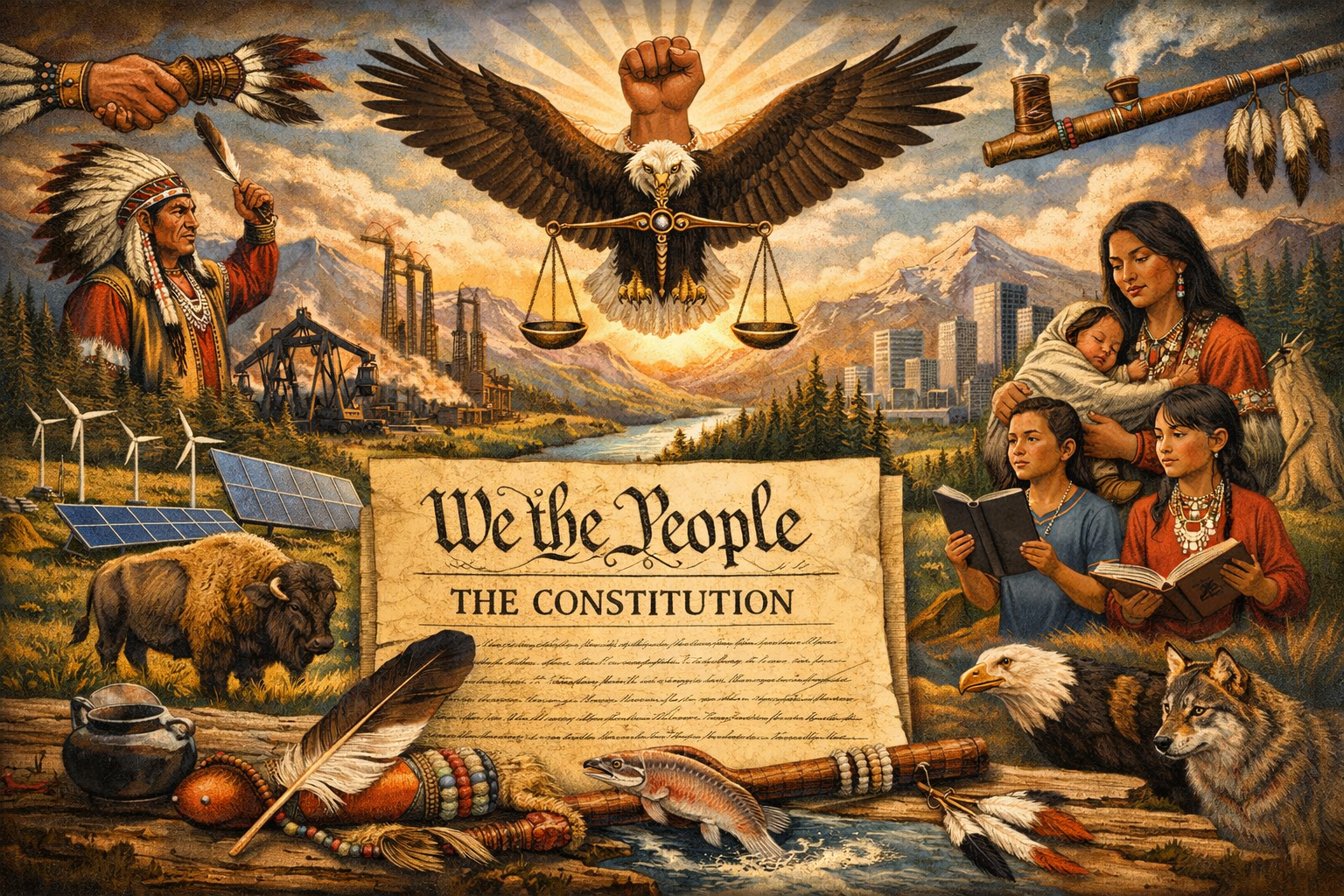
AOKFN Constitution
CONSTITUTION OF THE ANISHINAABE OF THE KITCHI ZIBI FIRST NATION
PREAMBLE
We, the Anishinaabe of the Kitchi Zibi First Nation, descendants of the families recorded in Petition 115, affirm that our inherent sovereignty, our sacred relationship to the land, and our right to govern ourselves are protected under:
- The United Nations Declaration on the Rights of Indigenous Peoples (UNDRIP), and
- The Constitution of Canada, including section 35 of the Constitution Act, 1982.
These instruments recognize our inherent rights, our continuity as a people, and our authority to maintain and strengthen our political, legal, economic, social, and cultural institutions.
Our sovereignty predates the Crown and Confederation. It has never been surrendered, ceded, or extinguished. We enact this Constitution to protect our people, our lands, our laws, and our future generations.
SECTION I — SOVEREIGNTY AND INHERENT RIGHTS
1.1 Inherent Sovereignty
The Anishinaabe of the Kitchi Zibi First Nation are a sovereign Indigenous nation. Our sovereignty originates from our ancestors, our laws, and our relationship to the Kitchi Zibi watershed.
1.2 Recognition of Rights
Our inherent rights are recognized and protected by:
- UNDRIP
- The Constitution of Canada
- The Royal Proclamation of 1763
- Pre‑Confederation Crown recognition of Petition 115 families
1.3 Continuity of Petition 115
The descendants of Petition 115 constitute a continuous Indigenous nation recognized by the Crown before Confederation, with rights equivalent to reserve‑holding nations.
1.4 Non‑Derogation
No external government may diminish, override, or extinguish our inherent rights, jurisdiction, or identity.
SECTION II — NATIONAL PURPOSE AND PRINCIPLES
2.1 Purpose
This Constitution exists to:
- Protect our lands, waters, and people
- Restore and uphold our governance
- Ensure cultural and legal continuity
- Provide a framework for self‑determination
- Guide future generations
2.2 Guiding Principles
Our governance is guided by:
- Mino Bimadiziwin — the good life
- Respect for all beings
- Reciprocity with the land
- Responsibility to future generations
- Honour in leadership
- Transparency and accountability
- Trust in God
SECTION III — TERRITORY AND LAND RIGHTS
3.1 Unceded Territory
The territory of the Anishinaabe of the Kitchi Zibi First Nation consists of the lands historically stewarded by the families of Petition 115. These lands are unceded and as such remain under our jurisdiction.
3.2 Aboriginal Title
We hold Aboriginal title to our lands, including:
- Exclusive use and occupation
- Decision‑making authority
- Benefit from the land and its resources
- The right to Protect and Enforce laws in accordance with our traditions
3.3 Protection of Land
No land may be sold, surrendered, or transferred without the free, prior, and informed consent of the nation.
3.4 Stewardship Responsibility
We hold a sacred duty to protect the land, waters, plants, animals, and all relations for future generations.
SECTION IV — CITIZENSHIP
4.1 Citizenship by Descent
Citizenship is held by the descendants of the families recorded in Petition 115.
4.2 Citizenship by Adoption
The nation may adopt individuals into citizenship according to Anishinaabe law and custom.
4.3 Citizenship Rights
Citizens have the right to:
- Participate in governance
- Access community programs
- Practice culture and ceremony including religion
- Live in peace and security
- Benefit from the land
4.4 Citizenship Responsibilities
Citizens must:
- Uphold Anishinaabe law
- Protect the land
- Respect elders and teachings
- Contribute to community well‑being
SECTION V — GOVERNANCE STRUCTURE
5.1 The National Council
A. Composition
The National Council consists of:
- A Chief
- Clan or Family Representatives
- Knowledge Keepers (advisory role)
B. Authority
The National Council:
- Enacts laws
- Oversees governance
- Protects rights and lands
- Represents the nation in external relations
- Ensures accountability
C. Decision‑Making
Decisions are made by:
- Consensus, where possible
- Supermajority vote when consensus cannot be reached
5.2 The Office of the Chief
A. Role
The Chief:
- Serves as the primary leader and spokesperson
- Upholds the Constitution
- Protects the rights of the nation
- Ensures the Honour of the Nation in all dealings
- Oversees implementation of laws
B. Selection
The Chief is selected according to Anishinaabe custom and affirmed by the families.
C. Accountability
The Chief is accountable to the National Council and the people.
5.3 Elders and Knowledge Keepers
A. Role
Elders and Knowledge Keepers:
- Provide cultural, legal, and spiritual guidance
- Interpret Anishinaabe law
- Support dispute resolution
- Safeguard teachings
B. Authority
Their guidance is binding in matters of cultural law.
SECTION VI — LAW‑MAKING AND LEGAL SYSTEM
6.1 Anishinaabe Law
Our legal system is rooted in:
- Customary law
- Oral teachings
- Clan responsibilities
- Natural law
6.2 Law‑Making Authority
The National Council may enact laws concerning:
- Citizenship
- Land stewardship
- Justice and dispute resolution
- Governance
- Cultural protection
- Economic development
- Security and peacekeeping
6.3 Enforcement
The nation has the right to:
- Enforce its own laws
- Maintain peace and security
- Self Police on our Territory
- Establish community peacekeepers
- Resolve disputes internally
SECTION VII — JUSTICE AND DISPUTE RESOLUTION
7.1 Restorative Justice
Justice shall be guided by:
- Restoration
- Balance
- Healing
- Responsibility
7.2 Dispute Resolution Council
A council of Elders, Knowledge Keepers, and appointed mediators shall resolve disputes.
7.3 Jurisdiction
The nation has jurisdiction over:
- Internal disputes
- Citizenship matters
- Land matters
- Cultural and ceremonial matters
- Governance disputes
SECTION VIII — RELATIONS WITH OTHER GOVERNMENTS
8.1 Nation‑to‑Nation Relations
All relations with external governments shall be conducted on a nation‑to‑nation basis.
8.2 Free, Prior, and Informed Consent
No government or corporation may undertake any activity on our lands without the free, prior, and informed consent of the Anishinaabe of the Kitchi Zibi First Nation.
8.3 International Standing
The nation may engage with international bodies to protect its rights.
SECTION IX — AMENDMENTS
9.1 Amendment Process
This Constitution may be amended by:
- A supermajority of the National Council
- Ratification by the families
9.2 Protection of Inherent Rights
No amendment may diminish inherent rights, land rights, or sovereignty.
SECTION X — RATIFICATION
This Constitution comes into force upon ratification by the families of the Anishinaabe of the Kitchi Zibi First Nation and shall serve as the supreme law of our people.